Kruševac
Kruševac brings together the remains of Prince Lazar’s medieval seat, the architecture of Moravian Serbia and later layers of public memory. The old citadel and Lazarica, the monument in the central square and the memorial landscape of Slobodište tell distinct parts of that history.
History of the city
The founding of Lazar’s fortified seat is usually dated to around 1371, when he was consolidating his rule in Moravian Serbia. A charter of 1387 confirming trading privileges for merchants from Dubrovnik names Kruševac as Lazar’s town. The fortifications protected a court complex whose buildings served administrative, domestic and religious purposes.
Lazar died after the Battle of Kosovo in 1389. Kruševac remained important to the Lazarević dynasty before Stefan moved his seat to Belgrade. The battle became the subject of religious writings and epic poetry. These later traditions help explain how the event was remembered, while charters, surviving buildings and archaeological finds document the medieval town itself.
Later Kruševac developed as a town of trade and crafts. The domestic collection in the Simić House gives a view of urban life around the turn of the twentieth century. The monument unveiled in 1904 and the memorial park designed in the 1960s show how later generations reshaped the city’s public spaces around different histories.
Medieval sites
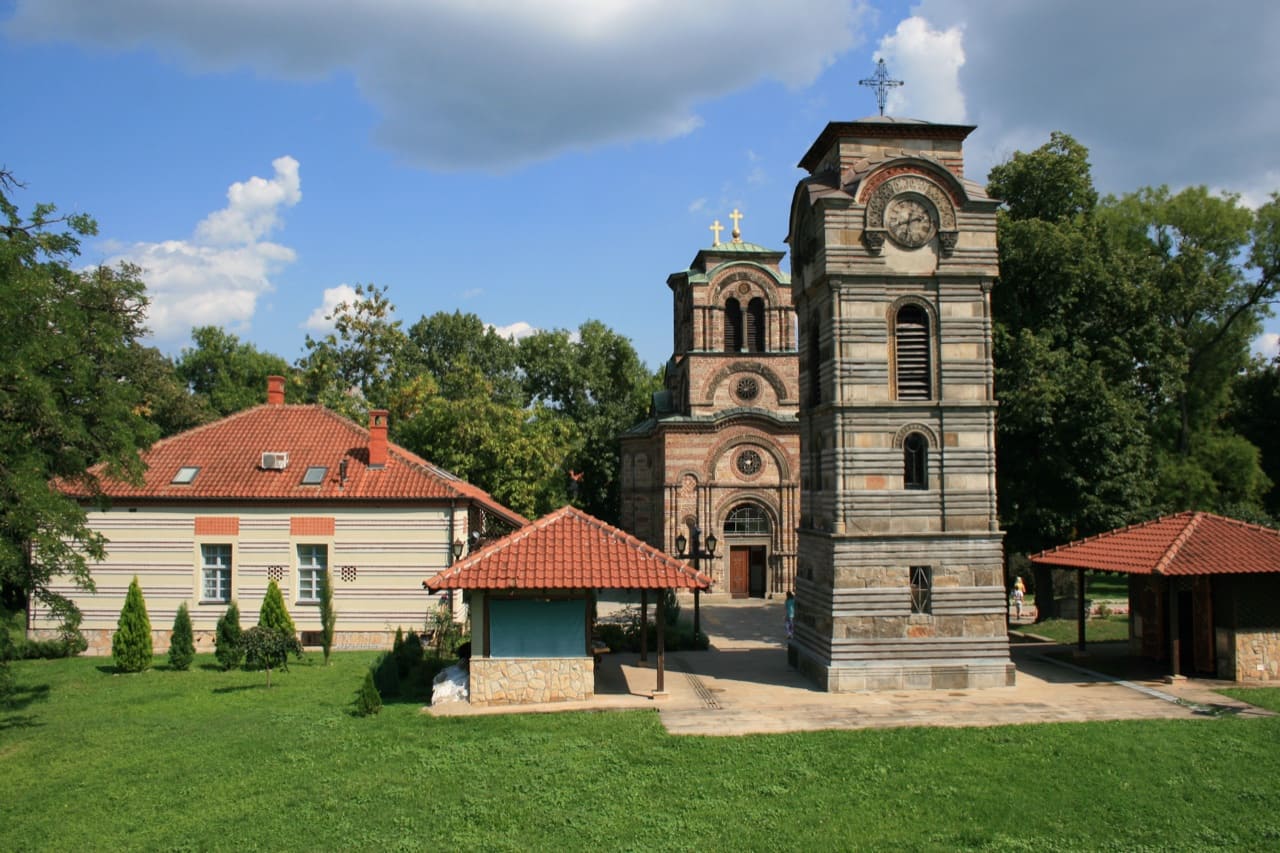
At Lazarev Grad, compare the surviving defensive masonry with Lazarica’s patterned stonework. Both belong to the same court complex, but their functions differed: one secured its entrances while the other served as the court church.
Monuments and memorials
The central square interprets the medieval past through a public monument of 1904. Slobodište commemorates victims of the Second World War through a different medium: earthworks, pathways and sculpted stone within a memorial landscape.
People connected with Kruševac
Prince Lazar Hrebeljanović established his court here and commissioned Lazarica. Princess Milica, his widow, took part in governing after his death while their son Stefan was young. Stefan Lazarević later ruled as despot. Kruševac commemorates him with a statue at Kosturnica Square.
The nun Jefimija was part of Milica’s circle. Her embroidered Praise to Prince Lazar belongs to the early literary and devotional tradition surrounding him. Centuries later, sculptor Đorđe Jovanović and architect Bogdan Bogdanović left their own marks on the city through the central monument and Slobodište respectively.
Museums and urban life
Visit the museum in the archaeological park to see how the material history of the region is presented. Continue to the Simić House for the history of domestic life in the old town.
A walk through the centre
Start with the Monument to the Heroes of Kosovo in the central square. Continue to Lazarev Grad and see the tower, Lazarica and the museum within the same complex. Finish at the Simić House. Treat Slobodište as a separate visit so there is time to walk through the memorial landscape.
Related places
Sources
- https://www.serbia.travel/en/krusevac/
- https://turizamkrusevac.rs/deo-ponude/crkva-lazarica/
- https://www.geonames.org/advanced-search.html?q=Serbien
- https://turizamkrusevac.rs/deo-ponude/arheoloski-park-lazarev-grad/
- https://turizamkrusevac.rs/en/deo-ponude/monument-to-kosovo-heroes/
- https://turizamkrusevac.rs/en/deo-ponude/slobodiste/
- https://turizamkrusevac.rs/deo-ponude/narodni-muzej-krusevac/
- https://turizamkrusevac.rs/deo-ponude/izlet-1-sareni-grad/
- https://turizamkrusevac.rs/deo-ponude/spomenik-despotu-stefanu-lazarevicu/
- https://doiserbia.nb.rs/img/doi/0350-7653/2020/0350-76532051023V.pdf
- https://doiserbia.nb.rs/img/doi/0584-9888/2006/0584-98880643077M.pdf